


GNSS disruption through jamming and spoofing is no longer a theoretical risk — it’s a growing reality and threat to safe maritime navigation worldwide.
This underlines why resilient GNSS solutions are becoming essential for maintaining navigational integrity in disrupted environments.
Tuesday - 20 January 2026
Maritime transport has, over the past decades, become increasingly dependent on satellite-based positioning systems, just like other transportation sectors and critical industries.
As geopolitical tensions have risen, so too has the number of incidents involving GNSS disruption through jamming and spoofing. These attacks cause incorrect navigation data and disruption to AIS information, increasing the risk of accidents at sea or causing costly interruptions when traffic is delayed or temporarily suspended. Particularly exposed are waters close to conflict-affected regions, including the southern Baltic Sea, the Gulf of Finland, northern Norway, the Black Sea, the Persian Gulf, and the Red Sea.
In poor visibility – darkness, fog, rain or snowstorms – the consequences can become especially serious, as traditional visual navigation cues disappear and mariners rely even more heavily on precise electronic positioning.
GNSS systems are often collectively referred to as “GPS,” GPS (US, Global Positioning System) is only one of several global constellations in operation. Additional systems include Galileo (Europe), BeiDou (China), and GLONASS (Russia). Together, they form GNSS – the Global Navigation Satellite System.
To increase precision and counter GNSS threats, modern shipping is deploying more advanced GNSS technology. Today’s receivers can utilise multiple satellite systems – GPS, Galileo, GLONASS and BeiDou – and operate on several frequencies simultaneously, such as GPS L1, L2 and L5. More satellites and more frequencies increase precision and reduce vulnerability. If one frequency is interfered with, the system continues to rely on the others.
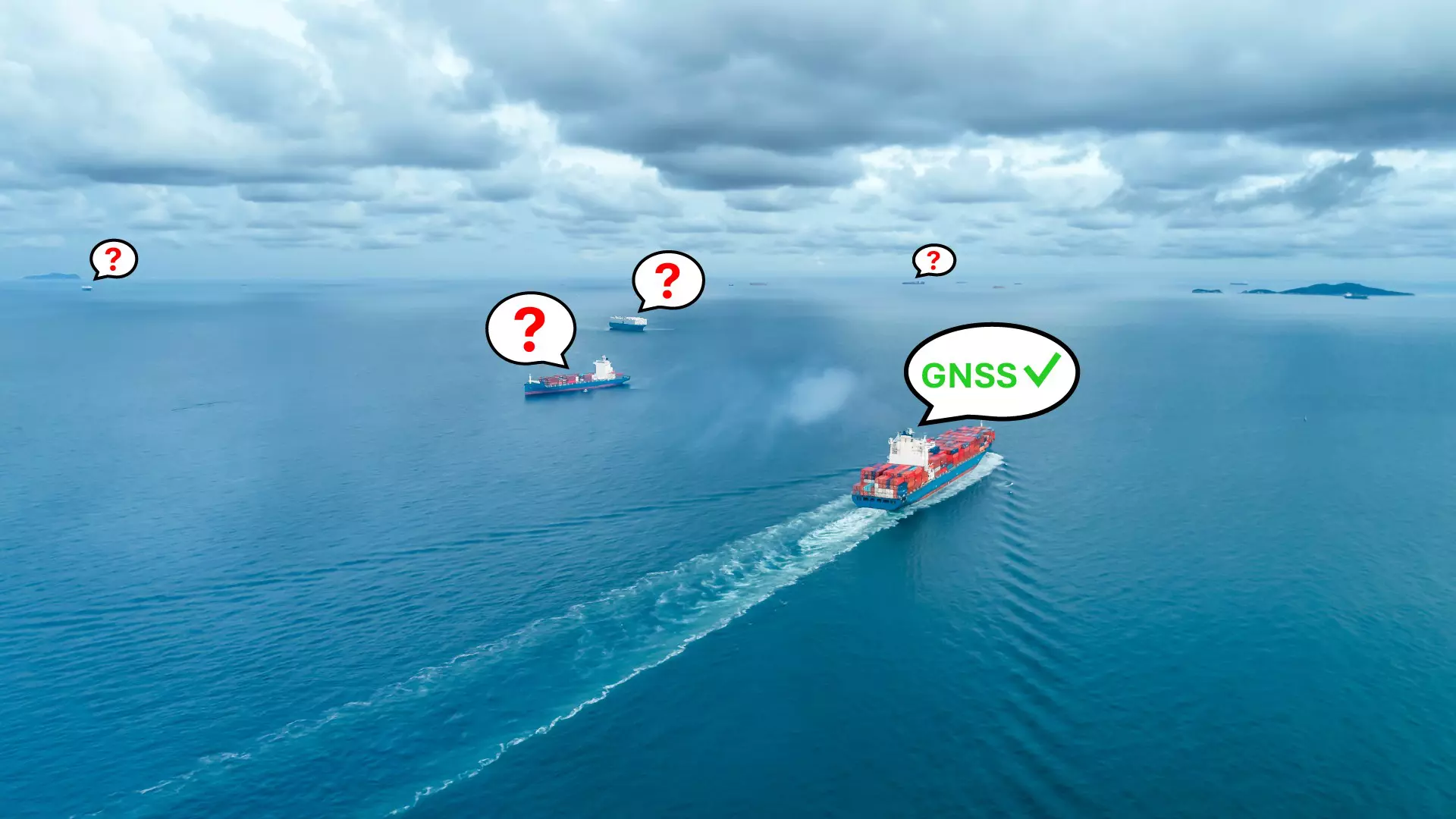
By comparing the characteristics of multiple frequencies, the receiver can also detect inconsistencies that may indicate spoofed signals. Differences in timing, phase or modulation patterns can reveal whether a signal is genuine or falsified.
Modern GNSS receivers are built on software-defined radio (SDR) platforms that use digital filters to improve performance in disturbed environments. These filters remove interference, clean signal paths, reduce multipath errors and isolate legitimate GNSS data to ensure more stable and accurate positioning.
Algorithms that analyse signal properties – such as strength, frequency and timing – help identify false signals. By cross-referencing data from multiple satellite systems and frequency bands, the receiver can isolate anomalies and add an extra layer of protection against both jamming and spoofing attempts.
An important part of strengthening GNSS resilience is the antenna system. Antennas designed to attenuate interference or active CRPA antennas (Controlled Reception Pattern Antennas) can identify the direction of jamming sources and suppress signals arriving from those directions.
Originally restricted for military use, CRPA technology is now becoming increasingly accessible. These antennas dynamically adjust their reception patterns to prioritise legitimate satellite signals, optimise the signal-to-noise ratio and reject interference from spoofers or jammers.
In 2024, former Saab TransponderTech – now FLIR TransponderTech – launched two new SOLAS-approved GNSS receivers: R6 NAV PRO RTK and R6 NAV PRO Compass. These systems are built to meet the demands for high precision and resilience at sea, particularly in traffic-dense coastal zones and busy port environments.
At the same time, development of the next-generation AIS system, VDES, is progressing. FLIR TransponderTech collaborates with maritime authorities worldwide, and active testing with coastal stations, vessels and satellites is ongoing. Future VDES services will make it possible to report areas experiencing active jamming or spoofing in real time, providing mariners with valuable situational awareness.
GNSS is a cornerstone of maritime infrastructure and is critical for the global economy and supply chain. In regions with complex navigation conditions or frequent interference, ensuring GNSS robustness is essential to maintaining safe operations, preventing traffic disruptions, and securing reliable access to ports. Strong technological development is underway to ensure that GNSS performs even under pressure – a necessity for modern shipping.
The demand for resilient GNSS systems has increased significantly since the beginning of 2025, as fleet operators seek more robust solutions to maintain operations in GNSS-compromised areas around the world. Standard single-band (L1) receivers—GPS/DGPS or GNSS/DGNSS—are simply not enough.
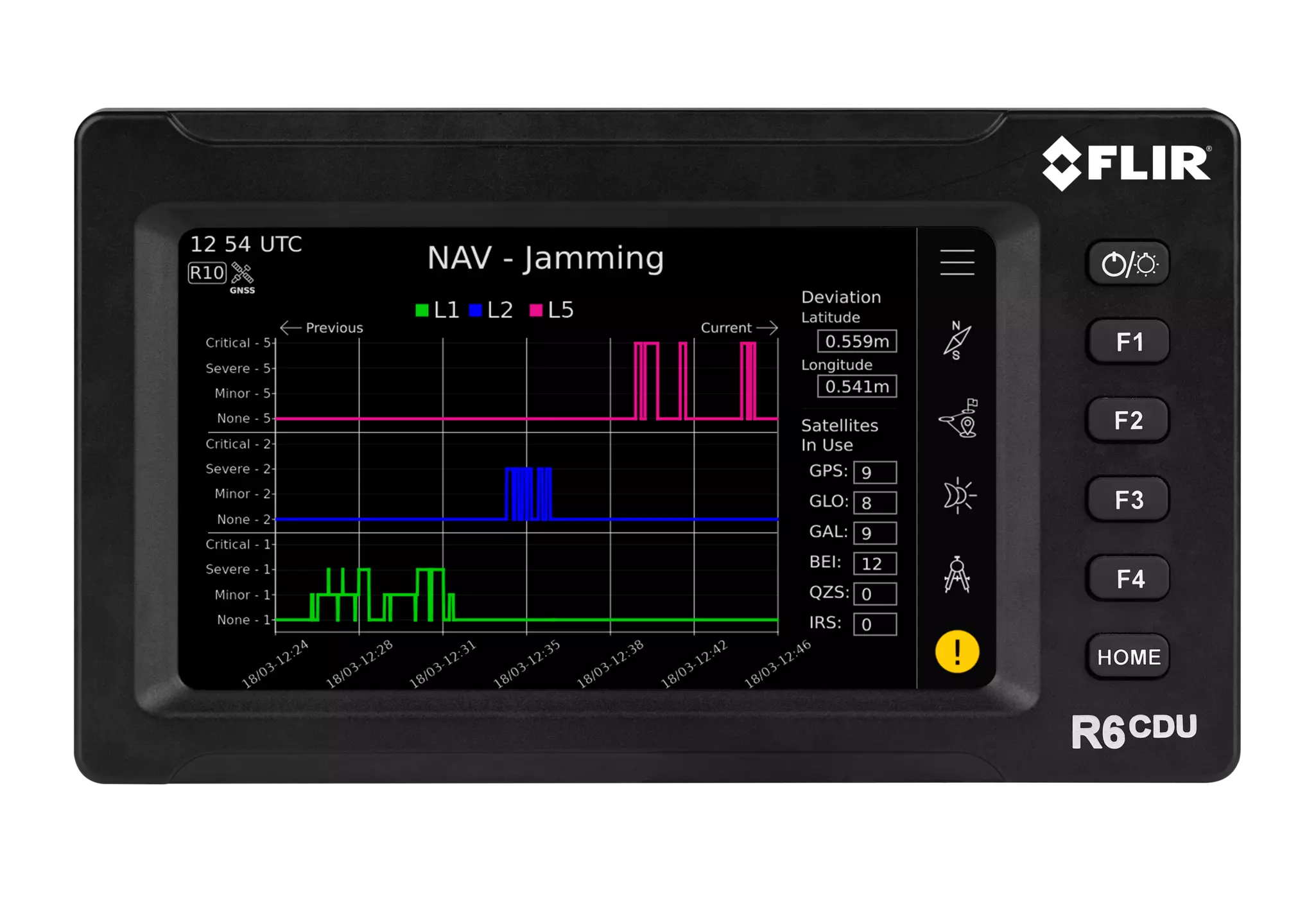
In some cases, one or several backup solutions have been installed alongside “GPS1” and “GPS2”. However, the response we consistently see is that true resilience to jamming and spoofing can only be achieved through multi-band coverage (L1/L2/L5), supported by a receiver capable of maintaining an accurate position even if one or two frequency bands are completely jammed or blocked.
When replacing legacy L1 receivers, using an IMO type-approved solution is essential to maintain GNSS resilience in the ECDIS integration. This places the R6 NAV PRO RTK and R6 NAV PRO Compass in a unique position to provide type-approved, resilient DGNSS options to upgrade the existing “GPS1” and “GPS2” setups.
A jammed receiver is also more vulnerable to spoofing. While both R6 NAV PRO options offer multi-band resilience to interference, the new dual-antenna R6 NAV PRO Compass additionally provides spoofing detection. Spoofing—where a false position is presented—is more dangerous and generally harder to detect. In scenarios where spoofing is partially or fully “successful,” having reliable detection is critical.
The R6 NAV PRO RTK and R6 NAV PRO Compass have proven to maintain operation longer than other type-approved alternatives and outperform other backup solutions. The added spoofing detection in the R6 NAV PRO Compass is highly valued, alongside its precise heading capability and IMU-enhanced motion monitoring.

Viking XPRS was experiencing severe issues with jamming and spoofing in the Gulf of Finland, and can now navigate Helsinki – Tallinn with confidence and high accuracy through narrow coastal passages.
FLIR TransponderTech provides resilient IMO type-approved solutions to merchant, workboat and government fleets, enabling seamless bridge integration and BAM-compliant alerts—outperforming other available options.
Get in touch: Connect with our experts for more information or Find a distributor to request a quote.

The R6 NAV GNSS/DGNSS delivers robust, IMO-compliant navigation with class-leading performance, intuitive interface, and seamless system integration.

The R6 NAV PRO Compass delivers high-accuracy position and motion monitoring with inertial support, redefining maritime navigation for professionals.

The R6 NAV NEO ensures reliable navigation for NeoPanamax vessels transiting the Panama Canal, with jamming resilience and IMO-compliant precision.